Man of Steel was released on Blu-Ray and DVD today, so I thought it would be a good time to bring out something I originally posted on Facebook a few months back.
Okay, by this point, most of you are probably are aware that, in
Man of Steel,
Superman kills General Zod; more specifically, he twists his neck until
he's dead in order to prevent his heat vision from turning a handful of
innocent bystanders into ash. This, of course, sparked immediate debate
among the fan community with some insisting that, "Superman does NOT
kill" while others responding that "He HAS killed" and, still others,
reasoning that, "in the modern world, he would HAVE to kill in order to
be effective." I hope to address each of those positions in this post
and, maybe, give you a bit more insight into why this is such an
important issue for superfans.
Okay, first of all let me address the "Superman has killed before" argument: more specifically, he has killed
General Zod before, in both the comic books
and the movies. Most famously, he killed Zod in
Superman II, the film that is often cited as the best Superman movie. This can be excused for a couple of reasons:
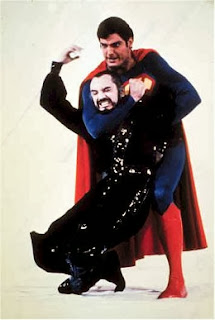
- Rather than squeezing the life out of him with his bare hands, as he does in Man of Steel,
Superman tosses Zod into a smoke filled chasm. Any comic book fan can
tell you, this does NOT mean that Zod is dead; as long as there's no
body, they can come back (and sometimes even when there is--- Jason
Todd, I'm looking at you). Sure, the assumptions is that he 'died' but
this was in the Fortress of Solitude; for all we know, those chasms were
the gateway to the Phantom Zone or something. In fact, there are cut scenes (which were re-inserted for certain re-releases and telecast) where it is revealed Zod was not actually killed and Superman happily drops off the newly de-powered villains in an earthly prison.
- Even if we assume that it was the filmmakers' intention to have Superman kill Zod (the deleted scenes would indicate it wasn't) the makers of Superman II
can be forgiven for one simple reason: They didn't
know any better! You see, this was a film made by a bunch of middle-aged
guys who hadn't read a comic book since they were kids and, while they
were certainly familiar with the basic premise of the character (strange
visitor from another planet, more powerful than a locomotive, faster
than a speeding bullet, etc.), they may not have been as familiar with
some of his more subtle characteristics; in other words, they weren't
exactly fanboys. And, Let's be honest, these guys should just be
applauded for successfully moving the live-action superhero beyond the
1960's Batman.
As for other instances (particularly in the
comics) where Superman has killed, the answer is a bit more
complicated. You see, Superman is a character with a 75 year
publication history; dozens, if not hundreds, of creators have
interpreted and re-interpreted the character in, literally,
thousands
of stories and, yes, a few of them have had Superman take lives (note:
when one looks at EVERY story EVER told with a superhero, I doubt you
can find ANY superhero who is NOT guilty of manslaughter.... except
maybe Captain Marvel). Previous stories are often reworked or just out
and out ignored by subsequent writers. So, let's simplify it a bit: to
all the stories where Superman takes a life that were written before,
say, 1985, I will also give them the "they didn't know any better
pass."
You see, in the mid-1980's, works like
The Dark Knight Returns and
Watchmen
ushered in an era where superheroes were analyzed much more closely.
They were deconstructed and picked apart and the little things that made
them distinctive, rather than being guidelines, now became guiding
principles for the characters. It wasn't just a 'general rule' that
Superman didn't kill; it was a defining part of his persona. So, let's
look at the instances since this point where Superman has killed. First
of all, there aren't many; these days when Superman kills somebody,
more often than not, it turns out to be some sort of alternate reality
where Superman ends up setting up some sort of new world order that he
rules with an iron fist. In fact, that is the entire premise of the new
video game
Injustice.
As for the mainstream continuity stories, there are two of note:
- Superman,
again, executes General Zod. This was in the late 80's during John
Byrne's run where he attempted to redefine and modernize the character.
Superman, executes a trio of Kryptonian villains fearing what might
happen if three evil versions of himself were ever unleashed on the
earth. First of all, this story was intentionally supposed be shocking;
it was meant to play off of the expectation that Superman does NOT
kill. Secondly, over the course of several issues, there is fallout
from this that sends Superman into a downward spiral of despair and
results in his vowing to never kill again. Also, this story has pretty
much been ignored for most of the last 25 years and, in comics, when a
story is ignored long enough--- you can pretend it didn't happen.
- Doomsday:
This one is tricky. It was a fight to the death but, what most tend to
remember about this fight is not Doomday's death but Superman's.
The final blow killed BOTH characters. Also, it turned out that
neither one really died--- also, this story was basically just a way to
sell comics by 'killing' Superman. Also, it was a pretty stupid story.
So,
there are a couple of instances where Superman has killed in the last
25 years or so--- but they're mostly either ignored or just shitty
writing; the best stories stick with the 'no kill rule'. Which brings
me to my next point: In the best Superman stories, Superman is depicted
has having an absolute no kill rule. Among the three best Superman
stories ever told are Alan Moore's
Whatever Happened To The Man of Tomorrow?, Grant Morrison's
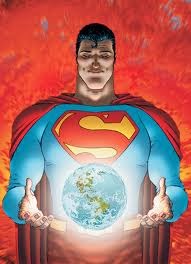
All-Star Superman, and
Mark Waid and Alex Ross's
Kingdom Come. Superman's no kill rule is explicit and unbending in all of these; in fact,
Whatever Happened to the Man of Tomorrow
ends with a Superman so distraught over having to kill one of his foes
that, as penance, he exposes himself to Gold Kryptonite, wiping out his
own powers forever.
So, in short, Superman has been allowed to kill in some stories but never in the best ones.
So, what about the idea that a 'more realistic' Superman would
have to
kill in order to be effective. True, in the real world, heroes,
especially in the case of police and military, have to kill but, you
know what's great about Superman? He doesn't live in the real world.
If you're going to approach him realistically, you're already kind of
missing the point. Superman isn't supposed to be a reflection of
reality; he is supposed to represent an ideal. In the real world,
sometimes it is necessary to kill but, in an ideal world, it shouldn't
be. We should aspire to be something greater. That is what Superman
represents; he is able to achieve the things that we cannot achieve. In
fact, I would argue that, the more bleak the real world becomes, the
more important it becomes that Superman retains his principles. What's
great about all fiction is that it isn't bound by the rules of
reality.
So, in the end, the question is not
has Superman killed nor is it
would Superman kill but
should Superman
kill? More specifically, when re-introducing this character to a new
generation, if you're going to be true to the ideals that the character
has come to represent over his 75 year history,
SHOULD you allow him to kill? The answer is no.
So, a few ways the filmmakers could have done it better:
- Obviously, he doesn't kill
Zod; make the stakes something else. Perhaps he has to choose with
preserving Krypton's knowledge or saving a human, or make it so his
actions result in Zod's death but it's not his hands around his neck;
maybe it turns out that, not growing up here, Earth's atmosphere is
toxic to him--- so Superman can either let the terra-forming continue,
which would allow Zod's survival, or allow Zod to die--- it's not
perfect, but you see where I'm going with this? This is off the top of
my head, certainly given enough time the writers could have come up with
something better.
- He still kills Zod but the stakes are much
higher: In the film, Zod is killed because he attempted to kill a small
group (about a dozen) people with heat vision. If you really want to
justify Superman using lethal force, put the whole city of Metropolis
(hell, the whole planet earth) at risk. Superman kills Zod or millions die; that's more feasible.
- He
eventually has to kill but NOT IN THE FIRST MOVIE, you build up to it;
establish the rule, thus it is that much more significant when it is
broken.
Also, they can redeem themselves in the sequel.
I'll give them credit, in the film, Superman is obviously remorseful for
his actions. Maybe they'll bring this up in the sequel; perhaps it
will haunt him and be the reason he vows to never again take a life.
Maybe this was the plan all along but, given the sloppiness surrounding
some other plot details, I doubt it.
In conclusion, I just want to note that
Man of Steel is
by no means a bad movie; it's good summer fun with lots of Superman
punching things but, much like Superman itself, it should aspire to be
something better.

 The second volume, On Air- Live at the BBC Volume 2 was just released this fall and, while it doesn't come close to unearthing the number of buried treasures its predecessor did (in fact, their is quite a bit of redundancy between the two), it is still just as charming and continues to capture the warmth and energy of the previous collections live performances. In fact On Air seems less concerned with unearthing new tracks than it is in documenting the performances of more well known tracks from the Beatles 'official' recordings. In fact, many of the band's early hits and standbys that were conspicuously absent from the first collection appear here. Among these are "Twist and Shout", "Money", "Please Mr. Postman", "I Want to Hold Your Hand", and "She Loves You".


