I originally started this blog in an attempt to get some semi-serious conversations going regarding my favorite goings on in the pop cultural landscape; here's my attempt to respond to, what I feel, is an unfair criticism of Guardians of the Galaxy; feel free to weigh in:
A Recent LA Times article accuses Guardians of the Galaxy of lacking a substantial plot. Granted, it has a clear MacGuffin but that doesn't necessarily make a story perfect; as a recent episode of The Big Bang Theory pointed out even the greatest MacGuffin movie of all time has an major flaw in its plot:
I suppose you could argue that Raiders isn't about what happens to the Ark but about the characters but, really, what effect does the quest have on Indy? Is it really transformative in any way? How is he different in any way by the end of the film? In that respect the first two sequels, Temple of Doom and Last Crusade, are clearly more successful. However, what Guardians does share with Raiders that I think is worth mentioning is this: they both introduce us to the characters and their world.
I think that what the author fails to realize about Guardians of the Galaxy,Avengers and most of the Marvel movies is that they are not stand alone films--- nor are they meant to be. When viewing a fresh addition to the franchise, it is best to view it more as the first episode of a TV series. Yes, the first Avengers can also be guilty of the absence of plot that was noted in Guardians as can Captain America: The First Avenger and Thor --- however, once we get to the films in what is being called Phase Two of The Marvel Cinematic Universe, Iron Man 3, Thor: The Dark World, and Captain America: The Winter Soldier, there is clearly a plot developing for each of these characters. In fact, as I have pointed out before, Iron Man 3 works as a sort of 'season finale' for Tony Stark and, when viewed in the context of the first two Iron Man films, you get a fully realized story-arc.
So, I guess what I'm saying is this: don't dismiss the Guardians yet--- as the franchise develops (as all the Marvel Cinematic Universe films develop) so will their plots. They're not absent, they're just decompressed; an entire story doesn't have to fit in one film anymore... or even within a single franchise. As we see more films, we will see more grounding in plot. Perhaps I'm more used to this idea because I grew up on comics--- I know what it is like to follow characters and see them develop over months or, even, years. I also know how seemingly disparate plot points in different titles can lay the groundwork for concepts that payoff in a culmination of sorts among different franchises. In fact, the practice has become downright exhausting in recent years. However, thus far the Marvel films have done an excellent job of providing films that work by themselves but also feed into a larger world that they are building.
While I am generally of the opinion that greatest hits albums are for, "housewives and little girls", every once in a while, there is a greatest hits album of such transcendent perfection, one that manages to both showcase the highlights of an artist's career while also working as a cohesive work in and of itself that it defies convention. Tom Petty and the Heartbreakers' Greatest Hits is just such a collection.
The album covers the first 15 years of Petty's career, one where his singles tended to overshadow the albums that they were drawn from. Granted, Damn the Torpedoes is a fine album, in fact, 4 songs from that very album are included on Greatest Hits, but, among the remaining 5 songs, there aren't exactly any buried treasures waiting to be discovered. I would even argue that Torpedoes isn't even his best album; that title goes to 1994's Wildflowers.
In any case, Greatest Hits is a showcase for Petty's instincts as a master of pop song-craft. It contains anthem after anthem and we even get a taste of experimentation with the classic, "Don't Come Around Here No More." As a nice added bonus, we get the wonderful "Mary Jane's Last Dance"; sure, the video got overplayed but it gave us the first taste of the Tom Petty/Rick Rubin collaboration that would ultimately produce Wildflowers. So, sorry Bruce McCulloch, I gotta go with the Greatest Hits for my favorite Tom Petty album.
Key Tracks: All of them, it is a greatest hits album, but, most especially: "American Girl", "Refugee", "The Waiting", "You Got Lucky", "Don't Come Around Here No More", "I Won't Back Down", "Free Fallin'", "Mary Jane's Last Dance"
I am deeply saddened by the passing of Robin Williams. I was born in the late 70's and grew up in the 80's so, from reruns of Mork and Mindy, Live at the Met, and Comic Relief to Good Morning Vietnam, The Fisher King, and Goodwill Hunting, he has been an ever present ingredient in my own voracious pop-culture diet. Some of you may know that I do stand up and, while I can't say that I pattern myself on him in any way (mostly because I can't), to say that he in no way influenced my sense of humor or love of comedy would be a complete falsehood.
There have been many far more eloquent tributes and insights over the last couple of days, so I'll leave it at that but here are a couple that I found particularly insightful. This article examines what it was like to do improv with the man and here Norm Macdonald recalls what it was like for him meeting the funniest man in the world.
I leave you with this, my all-time favorite Robin Williams bit.
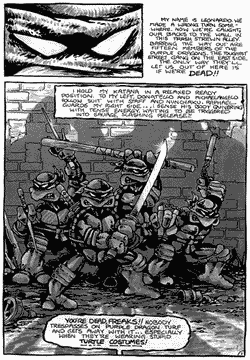
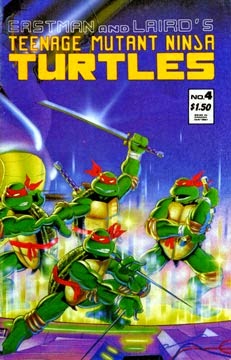
Friday will mark the release of the Michael Bay produced (although not directed) Teenage Mutant Ninja Turtle live-action movie. This year also marks the 30th anniversary of the Ninja Turtles themselves. Granted, the team of heroes in the half-shell didn't enter mass consciousness until the 1987 animated series and accompanying toy line but their humble beginnings were in a simple, black and white comic that creators, Kevin Eastman and Peter Laird, self-published almost exclusively for sale at a local New Hampshire comic-con in the spring of 1984.
Many fans are lamenting what horrors Michael Bay and company will visit upon the Turtles. Many details have leaked as to the various ways Bay is being unfaithful to the original concept but, there is an inherent problem with taking the Ninja Turtles this seriously: they were never meant to be taken this seriously. Many fans would be shocked at how dark that first, independently published comic was. Perhaps this is where the myth of 'serious' Ninja Turtles comes from. The problem is that it's not so much 'dark' as it is a 'parody of darkness'.
You see, the first issue of Eastman and Laird's Teenage Mutant Ninja Turtles was intended as a send up of some of the most popular comics of the day: they were Teenagebecause of Marv Wolfman and George Perez's popular New Teen Titans, Mutant because of Marvel's X-men and New Mutants and, finally, Ninja because of Frank Miller's Daredevil (which incorporated Ninjas in the form of a clan called The Hand and Daredevil's retconned sensei, Stick --- this is where we get The Foot and Splinter... get it? Get it?!?!). You'll also notice how the prose mimics Miller's own appropriation of the 'hard-boiled' aesthetic.
However, after the success of the first issue, the series quickly evolved to have a much lighter tone (albeit, still a far cry from the animated series). In fact, while I, like every ten-year-old of the time, was introduced to the Turtles through the animated series and toy line, once I became more sophisticated (11 or 12), I learned about the original, independent comics. To this day, my favorite version of the Turtles remains the one in those first couple dozen independently published comics. I owned a compilation that collected the first 10 or 11 issues of the series along with the individual turtle's 'micro-series' one-shots. In fact, a couple of recent hardcover collections have collected those same issues (there is also a colorized version but I feel the art shines better in the original black and white).
Many fans might be shocked that, in these initial stories, there is a distinct lack of catchphrases such as "Cowabunga" and "Turtle Power" and the team's trademark love of pizza (I'm pretty sure they ate pizza at one point, just not exclusively). These were all the product of the cartoon and toy line's marketing department. In addition, the early comics were black and white; the only color was on the covers where all four turtles wore red bandanas/masks. Nevertheless, the series was a lot of fun with inter-dimensional space travel and a lot of Jack Kirby-esque action (the Donatello one-shot is an all-out tribute to Kirby). In fact, the first live action TMNT movie from 1990 owes a great deal to the more terrestrial adventures of these early comics and it more closely resembles those than it does the super-silly cartoon of the same era.
However, what I find most interesting, was that all of these entities, the indie comic, the cartoon, the movie, managed to exist alongside one another. Archie Comics even did a series that initially started as a close adaptation of the cartoon but, very quickly, developed its own continuity and fan base. Eastman and Laird had shrewdly managed to license their characters without giving up total creative control. In an industry where there are dozens of stories about creators being screwed over while their employers make millions (and, now, billions) of dollars off of their creations, Eastman and Laird are a rare exception.
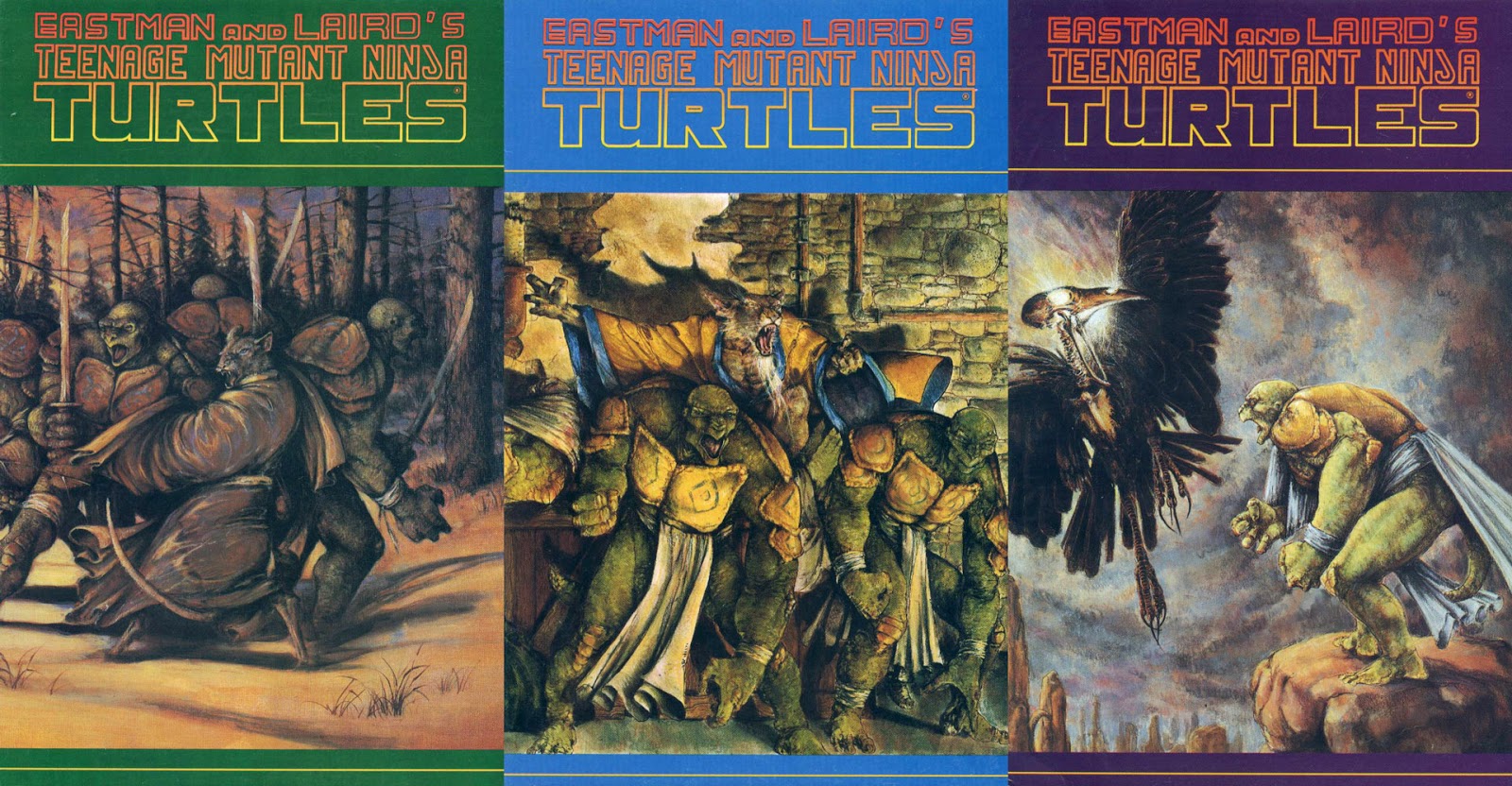
In fact, the sillier the licensed Teenage Mutant Ninja Turtles commercial juggernaut became, the more interesting the work on that original series became. As Eastman and Laird became more invested in the day-to-day management of their property, the original series became more of an anthology series with indie comics legends like Mark Martin, Rick Veitch, and Richard Corben stepping in with their own distinctive visions of the terrapin heroes, including a hyper-realistic version by Michael Zulli (famed for his wildlife drawings in his own Puma Blues) that was decidedly NOT for kids and which is, even now, a little bit creepy.
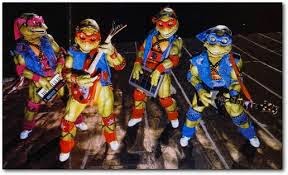
Yet, at the same time this was going on, the mainstream Turtles were embarking on the 'coming out of their shells tour' (which was really nothing more than a massive promotional tool for Pizza Hut).
A couple of years later, the Turtles would get their own live-action show so as to more effectively compete with the Power Rangers (this is the one with the female turtle, Venus). Meanwhile, Eastman and Laird would merge their own studio with Image Comics, the foremost proprietor of the 'grim and gritty' era of comics, and the stories would get even darker. Turtles were mutilated, lost limbs, were turned into cyborgs... in fact, this era may have gotten a little too dark as Kevin Eastman has pretty much disowned the stories of this era and has since rebooted the series himself.
I guess my point is this, the ninja turtles have always been this weirdly mercurial property; they have been shaped and reshaped again to assume multiple incarnations for a variety of different audiences, often at the same moment in time. The new movie will probably be terrible but, so what, that doesn't mean you can't still enjoy YOUR favorite version of the Turtles. For me, personally, it's the original black and white comic and that very first live-action movie from 1990.... oh, and I do enjoy saying "Go Ninja, Go Ninja, Go!" from time to time....
And, if the Turtles can survive Vanilla Ice, I think they'll safely make it passed Michael Bay relatively unscathed as well....
While the band's debut album, Appetite for Destruction, seems to get the most love these days, few people seem to appreciate how awesome their first their first proper follow-up was. The preceding release, Lies, was a combination of a previously 'independently released', 'live' EP and four new acoustic numbers. And, while the band did score a major hit from that release with the lovely "Patience", the Use Your Illusion albums are the true successor to Appetite.
Guns N' Roses always seemed liked one of those bands that was destined to burn out rather than fade away (which they sort of did--- only, miraculously, without fatality) so these two albums seemed like an effort to get as much of their material committed to tape as possible in as short a time as possible because, I mean, who knows how long they're going to be around?
Released separately on the same day, the two albums are, for all intents and purposes, a double album. Allegedly, the only thing that separates them is fact that Use Your Illusion I is primarily composed of songs that were written before Appetite for Destruction and its ensuing success and Use Your Illusion II is primarily songs written in the interim between. There would seem to be some truth to this as, not only are "Don't Cry" (with its original lyrics) and "November Rain" among what are widely considered the oldest songs in the band's repertoire but Illusion I seems to be the rawer, more blues based of the two.
It has often been said that the Illusion albums represent a conflict between Axl Rose's desires to construct more epic, multi-layered material (like "November Rain" and "Estranged") and the hard rock sensibilities of the rest of the band yet, somehow, the two seemingly contradictory aesthetics blend into what remains a sprawling, epic journey over the course of a whopping 30 songs. This is their White Album and, I have to say, it probably comes closer to that album in terms of sheer ambition than just about any album before or since.
Slash is often championed as Axl's foil, the blues-based yin to Axl's piano-ballad obsessed yang. However, Axl's real partner-in-crime (and the most crucial ingredient IMO of a true G N' R reunion) is actually rhythm guitarist, Izzy Stradlin. A perusal of the writing credits reveals that, either alongside Axl or on his own, Izzy was one of the dominant tunesmiths within the band (in fact, evidence suggest that many of the band's earlier songs--- while credited to the whole band--- were actually Rose/Stradlin or Stradlin compositions). In fact, he even takes lead vocals on a song from each album.
That's not to say that Slash is by any means a slouch; on "Estranged" Axl even thanks him for the 'cool riffs' and "Locomotive" is the most guitargasmic epic the band every crafted.
Bloated? Yes. In your face? Yes. A product of the Hard Rock Excess that Nirvana and their ilk would shortly wipe from the face of the earth? Oh, hell yes! But, is it still awesome after all these years? You better believe it.
Key Tracks: "Live and Let Die" "Don't Cry" (both original and alternate lyrics), "Civil War", "Knockin' on Heaven's Door", "14 Years", "November Rain", "You Could Be Mine", "The Garden", "The Garden of Eden", "Breakdown", "So Fine", "Coma", "Double Talkin' Jive", "Dust N' Bones", "Dead Horse", "Estranged"
While I knew very little of the current Guardians of the Galaxy team before seeing the trailer, I have had very high hopes for this film and it somehow managed to exceed them. In a way, that is to be expected; it is a team of comic book heroes that combines Star Wars with Raiders of the Lost Ark. There is no better recipe for a film that Scott will love! On the other hand, many lesser films have tried and failed in the past to create this formula and the results are usually a dismal failure(Ice Pirates, anyone?). Fortunately, James Gunn is just the mad genius to pull this off.
Chris Pratt's Star-Lord manages to successfully merge Luke Skywalker and Han Solo into one character (which would actually make his most direct cinematic predecessor Bill Pullman's Lone Star from Mel Brooks' Spaceballs). Pratt is the perfect mix of comic charm and wide-eyed enthusiasm to make this character work. Rocket could very easily have fallen into being mere comic-relief (unintentionally if not done well) but Gunn goes deeper with the character. He doesn't even waste time doing this; all the depth Rocket needs is established by allowing us to linger for a few seconds on the character's bare-back to see the remnants of the experiments that made him what he is. Sure, the character makes you laugh but you're always laughing with him or because of him, never at him. Zoe Saldana's Gamora successfully passes the Sexy Lamp Test ... even if only barely (maybe she'll get a bit more development in the sequel). At first, Dave Bautista's performance as Drax the Destroyer may seem bit wooden but, as we soon learn that his species is one that sees the world only in the most literal sense, it actually makes sense in a way. And Groot, well, Groot is probably the most lovable sidekick to grace a space opera since R2-D2.
What more can I say other than the film manages to work on every level: it moves at a lightning pace but still manages to give us enough character development for us to be emotionally invested. It's fun and funny and never takes itself too seriously. It might be the best movie yet from the Marvel Cinematic Universe but, it doesn't even need to exist in that world; it's great on its own merits.
Also: Best. Soundtrack. Ever! (well, maybe not EVER but... still... pretty damned good). American Hustle drew songs from roughly the same era but Guardians' soundtrack crushes them like a grape: David Bowie's "Moonage Daydream" played over the team touching down in KNOWHERE (the decapitated head of an ancient 'Celestial' giant)? Yes, please! The Runaways' "Cherry Bomb" as the team suits up for the climactic battle? I'll take two! And just wait until you see how "Ooh, Child" is used!
Sure, Guardians of the Galaxy may have been conceived as a way to introduce the cosmic elements of the Marvel universe to movie-goers, but the film manages to do so much more. In fact, this might be the finest Space Opera to hit since a little story that took place a "A Long time ago, in a galaxy far, far away...." I've said it before, I'll say it again, JJ Abrams had best be taking notes; THIS is your competition.
MAJOR SPOILER: So, does the post-credit scene mean we finally might get a good Howard the Duck movie?
Earlier this year marked the 50th anniversary of The Beatles invading America; this month marks the 50th anniversary of my favorite early Beatles album, A Hard Day's Night. Now, to clarify, the version of the album to which I am referring is the original British version which, since 1987 and the initial release of the band's catalog on CD, has been the dominant form available to most fans. In the states, through an agreement with United Artists, a soundtrack album was released that contained about half the songs from the album and a bunch of instrumentals that served as the score to the accompanying film (more on that later).
Not only is this my favorite album from the 'Beatlemania' era of the band, it is, in many ways, the first true Beatles album. First of all, it is the first album to contain no early Rock 'N' Roll covers; the album consists solely of Lennon-McCartney originals. Secondly, it is the strongest set of originals that the band had yet released. Many of the originals on the band's first two albums, Please Please Me and With The Beatles (and their American Counterparts Introducing.... The Beatles and Meet The Beatles) wore their influences on their sleeves. In other words, they weren't all that different from the songs they were covering by other artists (i.e. "I Saw Her Standing There" is, basically, a Little Richard song, "Love Me Do" is The Everly Brothers and "P.S. I Love You" and "Do You Want to Know a Secret?" were fairly indistinguishable from dozens of other pop songs of the era). The band had already had a significant breakthrough late the previous year with its final two singles of 1963, "She Loves You" and, especially, "I Want to Hold Your Hand". With these singles, the band began to establish a unique sonic vocabulary and these were, perhaps, the first songs that can truly be described as 'Beatle-esque'. However, on A Hard Day's Night, we are given a collection of 13 such songs. On top of that, every single song on the album could have been a hit single. And, the albums first single, "Can't Buy Me Love" is a work of such simple brilliance that one can't imagine how it could not have been written.
There is also a growing sophistication in the songwriting; sure, there's the traditional teeny-bopper fare in "I'm Happy Just To Dance With You" (and never had such a song been done better) but we also have "If I Fell" where Lennon sings, not to the one to whom he has pledged himself, but to another who seeks to tempt him away (by 1964 standards, pretty racy stuff).
Finally, on a technological level, this was the first album to be recorded by the Beatles entirely using four-track recording technology (the first two albums, believe it or not, had been recorded using only two tracks; "I Want to Hold Your Hand" and its UK b-side "This Boy" were the first recordings made by the band using four tracks). As a result of this leap in technology, the album sounds far more fresh and modern than their previous records. I remember hearing "Things We Said Today" in the early 90s and assuming that the song was from McCartney's solo career and was recorded sometime in the 80s!
To me, this will always be the album where the Beatles became the Beatles; sure, Rubber Soul and Revolver broke even further musical ground and are even better albums but, when I think of the loveable mop tops from Liverpool that first charmed the world, this is the album that is foremost in my mind.
Key Tracks: All of them? but especially: "A Hard Day's Night", "I Should Have Known Better", "If I Fell", "I'm Happy Just To Dance With You", "Can't Buy Me Love", "Things We Said Today", "You Can't Do That"
A quick note on the movie:
The film was once called "the Citizen Kane of Jukebox Musicals"; this is actually an enormous understatement. In order for that to be accurate, of all the movies ever made, Citizen Kane would have to be the only great movie ever made. A Hard Day's Night is really the only example of this particular type of movie as vehicle for pop-group/performer that manages to completely transcend the typical aspirations of such a work. There is nothing else in that category that comes close to being as good; even the band's own Help! pales in comparison (Purple Rain? --- which just celebrated an anniversary of its own--- have you watched it lately? Aside from the musical performances, it is terrible). Its faux-documentary style manages to naturally reflect the band's personalities without anyone having to 'act' too much and the script is charming and light-hearted and even manages some subtle satire regarding the youth culture of the era. Dick Lester also managed to create a new vocabulary for filming rock bands; previously, the technique had been: close-up of the singer, cut to the guitar player for solo. cut! But, since the Beatles had no one star, Lester showcased the whole band throughout each performance using pans, close-ups, and other techniques that I don't have the technical vocabulary to fully articulate. In short, A Hard Day's Night remains a unique artifact: a low budget, Rock N' Roll musical made in order to quickly cash in on the popularity of an artists that is actually good and, like the Beatles themselves, it has managed to endure.